
Grease Traps
Studies conducted by environmental organizations show that liquid waste from various human activities has a constantly increasing fat and oil content. However, when these fats and oils enter the sewer system, they cause gradual blockages and create unpleasant odors.
GREASE TRAPS
Plastic grease traps
Studies conducted by environmental organizations show that liquid waste from various human activities has a constantly increasing fat and oil content. However, when these fats and oils enter the sewer system, they cause gradual blockages and create unpleasant odors.
They can also damage various materials and components of sewage networks and biological treatment plants. When these fats reach biological treatment plants, they significantly reduce their efficiency. For this reason, commercial catering establishments are now required to install grease traps to ensure that the fats, oils, and fats (FOG) contained in washing waste do not enter the sewer system and are trapped at the source as a primary treatment stage. This waste usually contains high-temperature water, high organic load, FOG, detergents, and suspended particles—sediments from food residues.
Grease separators/grease traps in accordance with standard EN 1825 are manufactured from linear polyethylene using the rotation molding method, an extremely light and durable material. They function as gravitational traps, exploiting the difference in density between the components of the liquid waste from washing. Organic fats and oils have a density 10 to 15% lower than water and thus rise to the surface where they are trapped, forming a layer of oil/fat.
The various solids and suspended particles contained in liquid waste are separated inside the grease trap, where they settle at the bottom in the trap area. Grease traps can also be equipped with filters for collecting solids, in order to reduce the amount of sediment that settles at the bottom of the grease trap. Periodically, floating fats and sediments should be manually collected and removed from the sediment trap area.
Typical Applications
The grease trap is used in:
- Taverns,
- Restaurants,
- Fast foods,
- School and hospital kitchens,
- Food preparation facilities,
- Canning factories
- Dairy industries,
- Private residences,
- Hotels, etc.
Product line
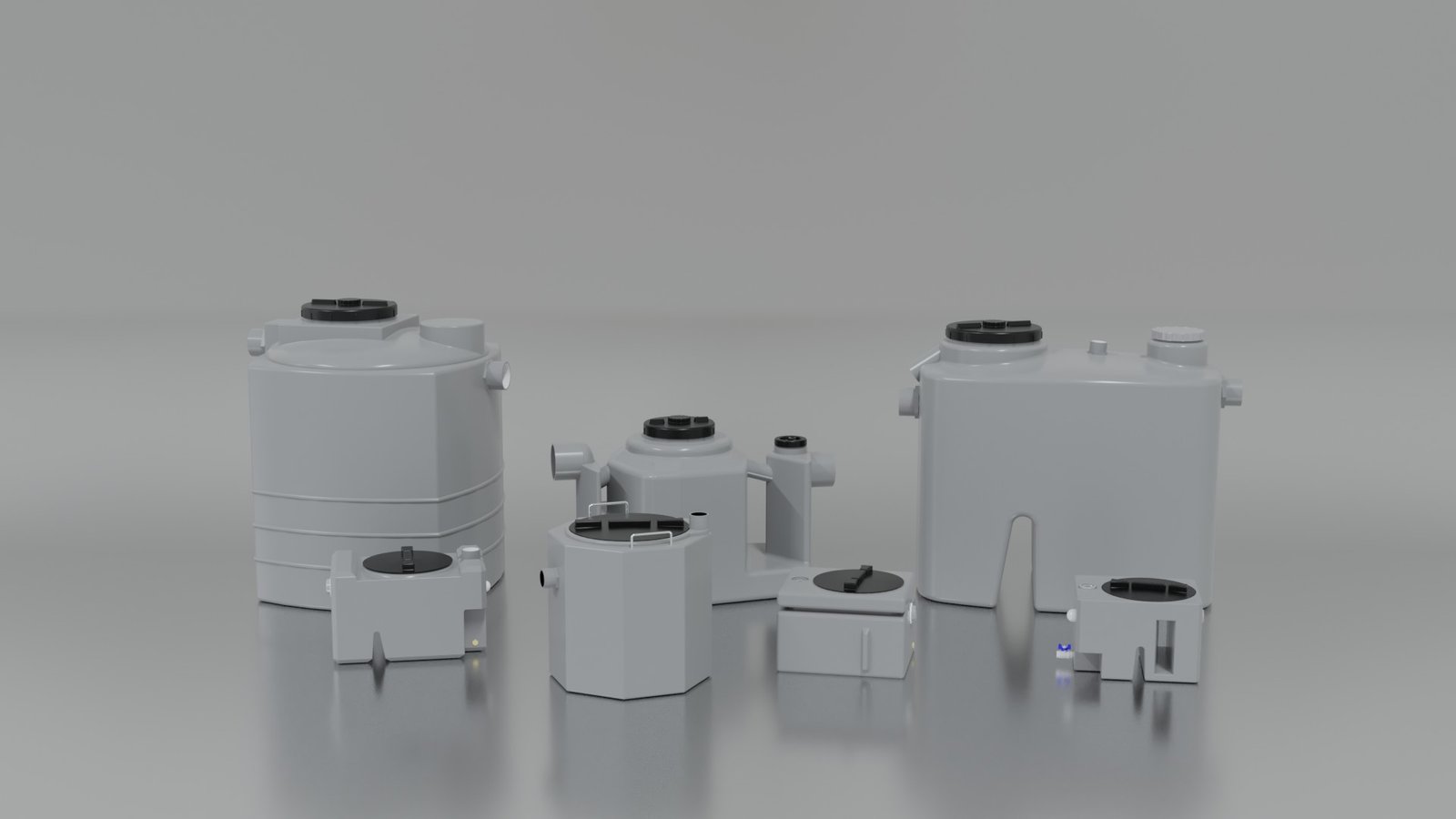
LIP grease traps are available in 7 sizes with capacities ranging from 40L to 1600L. They have a small footprint and are suitable for both indoor installation, inside the kitchen, and outdoor installation, above or below ground. To meet larger requirements, two or more units can be combined to provide the ideal solution in every case.
Construction Material
The grease traps are made of pure, non-recycled, linear polyethylene. The material offers high resistance to corrosion from fatty acids, monolithic construction without seams and joints. They are resistant to chemical corrosion, lightweight for easy transport and installation, and offer high resistance to mechanical stress.


