
Oil Separators Class I & Class II
Oil separators–oil collectors are prefabricated waste treatment systems suitable for gas stations, car washes, and car stations. They separate and retain the inert solids and petroleum products contained in liquid waste, as specified by European Standard EN 858.
These systems are classified into two main categories:
EN 858 class I with coalescing filter
EN 858 class II simple gravitational.
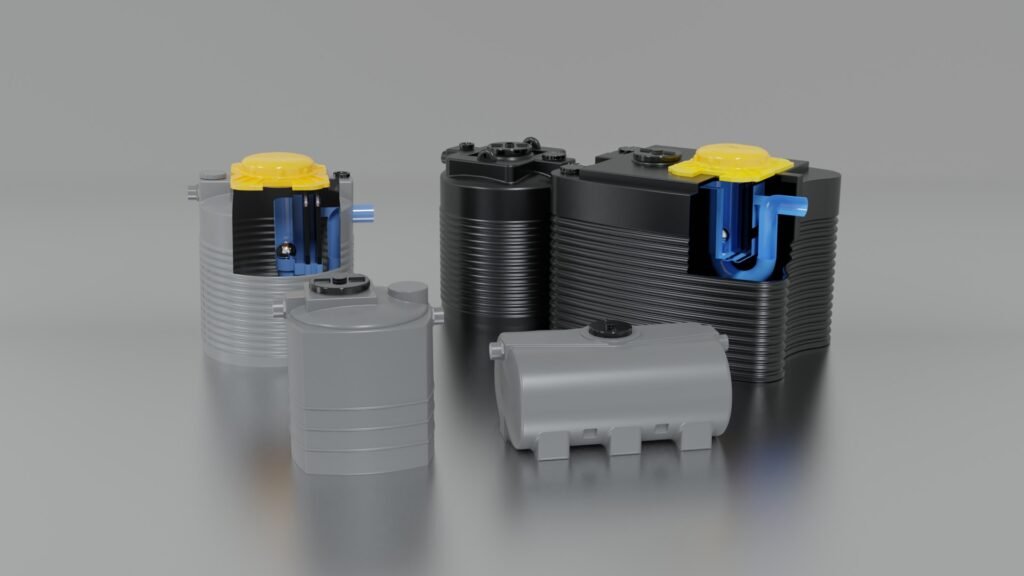
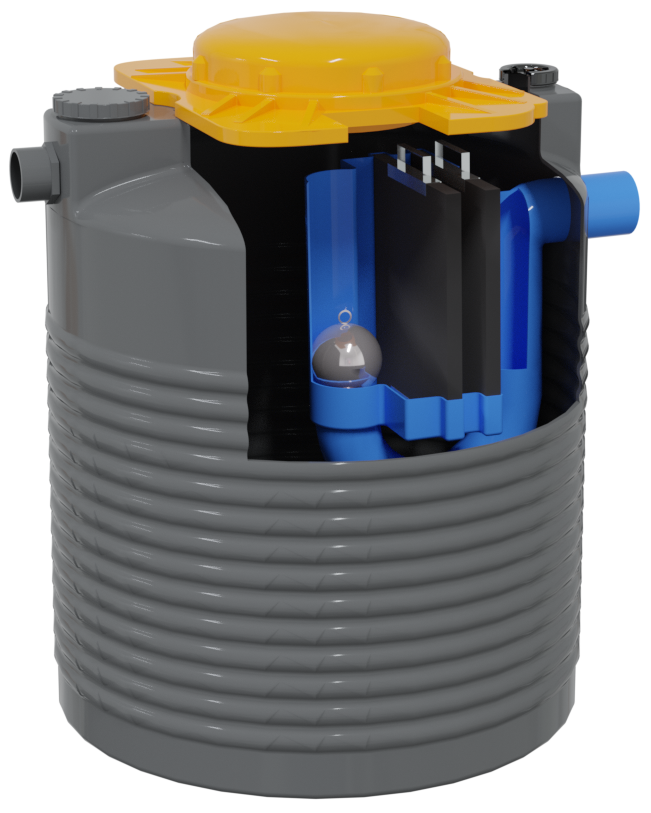
BlueSep EN 858 – 1 filter
Light liquid separation systems (e.g., oil, oil, and gasoline) according to EN 858-1, also called oil/oil separators, are wastewater treatment facilities in which light liquids are retained and separated. The operating principle is based on the difference in density between water and, for example, oil. The lighter phase (oil, gasoline, petroleum) floats and can then be skimmed off the surface of the water. The coalescence separator offers another effective method. Fine oil droplets are deposited on the surface of a special filter and eventually coalesce to form an oil film. Once a certain layer thickness is reached, the oil film breaks away and forms a larger oil drop which rises to the water surface and is separated.
With innovative synthetic fabric to maximize oil collection and an Oil Stop Valve that closes the system outlet when more separated oil than expected accumulates in it. The maximum permissible HC concentration at the outlet for a class I oil separator is 5 mg/l.
Oil separators / Oil collectors
Oil separators–oil collectors are prefabricated waste treatment systems suitable for gas stations, car washes, and car stations. They separate and retain the inert solids and petroleum products contained in liquid waste, as specified by European Standard EN 858.
These systems fall into two main categories:
ΕΝ 858 class Ι with Aggregation Filter
ΕΝ 858 class II simple gravitational.
Both of the above types can be equipped with an Oil Stop Valve, which closes the system outlet when a larger than expected amount of separated oil accumulates in it. The maximum permissible concentration of HC at the outlet for a class I oil separator is 5 mg/l and for a class II separator it is 100 mg/l.
The Nominal Size of a separator is a dimensionless number that corresponds to the amount of waste (in liters per second) that it can handle. It is calculated taking into account the geographical location of the facility, the area it needs to cover, and the type of equipment.
1. SAND TRAP / SLUDGE TRAP
Removes sand, inert solids, and granular waste, which can
cause damage to mechanical parts or accumulate in subsequent sections of the installation.
The difference in density between the various components of the waste is used for separation, and for this reason the liquids to be treated must be moved slowly to allow sufficient time for sedimentation. After separation, the solids are removed periodically.
2. OIL SEPARATOR / OIL COLLECTOR / PETROLEUM COLLECTOR
Oils and other petroleum products separate due to their difference in density from water and accumulate on the surface. The lower the flow velocity of the waste, the better the separation achieved.
The efficiency of the separator is dramatically improved by the use of a coalescence filter. The tiny oil droplets passing through the coalescence filter merge with others, increasing their volume and making them easier to transport to the surface of the separator. The oil layer should be removed at regular intervals.
Sensors (alarm controllers) can be installed in separation systems to detect the sludge level, the quantity of separated oils, and the maximum height of waste in the event of an outlet blockage.


